
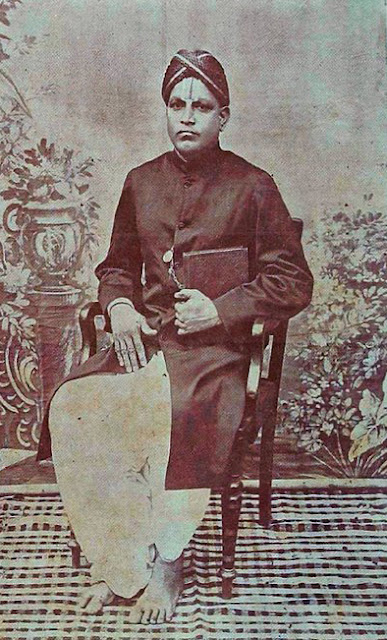
Early Life and Scholarly Journey of Ramanujachariar
Sri Manalur Veeravalli Ramanujachariar was the first person to translate Mahabharatham, the longest poem in the world (more than one lakh verses), from Sanskrit into Tamil. Sri Ramanujachariar was born in 1866 in a small village called Manalur in Tamil Nadu, located near Kumbakonam. He lost his father at a very young age and was brought up by his mother.
Young Ramanujachariar showed a keen interest in mastering languages, grammar, and ancient literature. He learned Sanskrit from his maternal uncle, Sri U Ve. Veeraraghavacharyar, an expert in Vyaakarana Sutras. After completing his matriculation, Sri Ramanujachariar went to Kasi to pursue higher learning in Sanskrit.
In Kasi, the principal of Queen’s College, Dr. Thibault, who was well known for his translation of Saint Ramanuja’s Sri Bhashyam into English, conferred the title of Pundit on Ramanujachariar. He stayed at Kumaraswamy Mutt (connected to Tirupanandal Adheenam) in Kasi and continued his studies. Due to his mother’s inability to bear the separation, he had to discontinue his studies and return to his hometown.
He then moved to the Thiruvaduthurai Adheenam and pursued his learning together with the junior Thambiran Ambalavana Desikar, who later became Head of Thiruvaduthurai Adheenam. There, Ramanujachariar met Tamil Thatha U Ve Swaminatha Iyer, and a lifelong association between the two began. U Ve Swaminatha Iyer asked Sri Ramanujachariar to join the Native High School, Kumbakonam, as a Tamil teacher and also to assist him in his works like Manimegalai and Civaka Sinthamani. Sri Ramanujachariar worked at Native High School between 1893 and 1911, after which he joined the Kumbakonam Arts College as a lecturer in 1911.
Mahabharata Translation and Legacy
During his stay at Kumbakonam, his learned friends encouraged him to take up the translation of Mahabharatham into Tamil. The work started in 1905, and the first Sanchikai (journal) on Aadhi Parvam came out in 1908. Despite the daunting task, huge financial commitments, and the difficulty of deciphering complex Sanskrit verses, he undertook the task with courage, wisdom, and confidence. Thanks to the encouragement and financial support from Sri U.V. Swaminatha Iyer and other eminent people in society, such as the Heads of Tirupanandal Adheenam and Thiruvaduthurai Adheenam, Sarva Shree Rao Bahadur V.T. Krishnamachariar, Diwan of Baroda, Brahmasri Sundarama Iyer, Colombo Ramanatham Chettiar, M.C.T. Muthiah Chettiar, Annamalai Chettiar, and many others, he was able to continue his work.
Since translating the great epic Mahabharata was a time-consuming job, he resigned from Kumbakonam College as a Tamil Pundit and dedicated his full attention to completing this divine work. He sought help from some learned Sanskrit scholars of the time for precise translation, including Sri T.V. Srinivasachariar, Painganadu Ganapathy Sastrigal, Kadalungudi Natesa Sastrigal, T.E. Srinivasachariar, and a few others. It took nearly twenty-five years to complete this translation, and the 45th and last Sanchikai was published in 1932.
The Tamil Mahabharatham, translated by him, is known as the Kumbakonam Edition. It is an extensive and complete translation done in a precise manner for the first time in Tamil. Sri Ramanujachariar’s Kumbakonam Edition is considered by great scholars for critical analysis of events in the Mahabharata.
On completion of his work, The Hindu newspaper praised him, saying that the author has rendered a great service to the Tamil language and to Tamil literature lovers. Likewise, the great Tamil scholar Sri U.V. Swaminatha Iyer, in his autobiography En Saritham, praised Sri M.V. Ramanujachariar for his marvelous contribution to Tamil literature. Dr. Annie Besant also praised Sri Ramanujachariar’s work, noting that his Tamil translation of the Mahabharata would help the Tamil people read the epic in their own language.
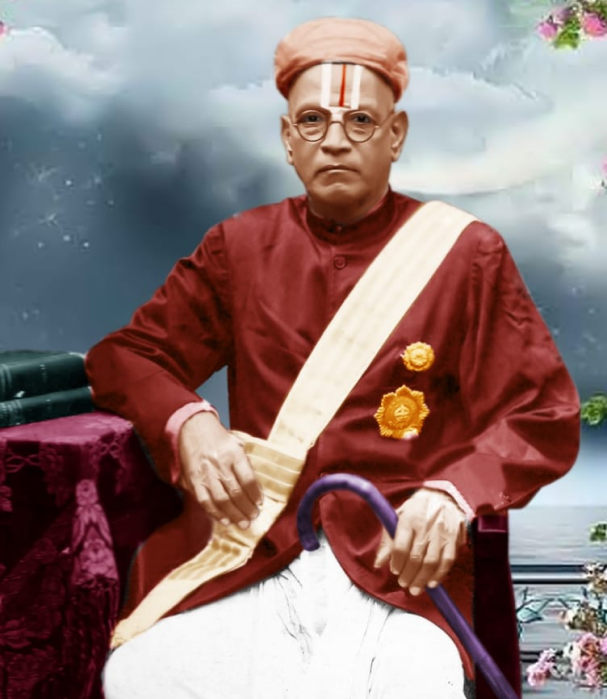 Sri Ramanujachariar served on the Madras University Academic Council for nearly 21 years as a member and contributed significantly to the growth of the Tamil language. He fought to ensure Tamil teachers’ pay was brought on par with teachers of other languages. The prestigious Sanskrit Academy of Chennai honored him with the title “Bhasha Bharathadurandara,” meaning a great scholar of many languages. The Governor General and Viceroy of India, Lord Linlithgow, conferred on him the title “Mahamahopadyaya” in 1936, a title accorded to scholars achieving greatness in various fields.
Sri M.V. Ramanujachariar passed away in 1940. Ananda Vikatan, a popular Tamil weekly magazine, published a tribute and obituary after his passing, mentioning him as ‘Bageerathar Maraindhar’. All India Radio also announced his death. Sri M.V. Ramanujachariar’s name will be remembered forever as one of the noble sons of Bharata for his yeoman service and immense contribution to Tamil literature and society.
Those interested in knowing more about M.V. Ramanujachariar and his works: Follow You-Tube Channel
Contact the Family of MV Ramanujachariar
Email – Manalurramanujam23@gmail.com
WRITTEN BY
R. HARISHANKAR
Email: tsharishankar@gmail.com