
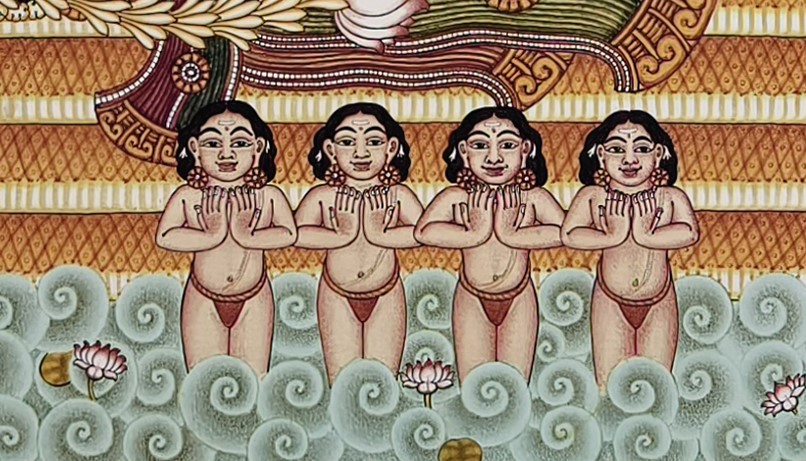
The Kumaras are four sages (rishis) from the Puranic texts of Hinduism who roam the universe as children, generally named Sanaka, Sanandana, Sanatana, and Sanatkumara. They are described as the first mind-born creations and sons of the creator-god Brahma. Born from Brahma’s mind, the Sanakadika Rishis undertook lifelong vows of celibacy (brahmacharya) against the wishes of their father. They are said to wander throughout the materialistic and spiritualistic universe without any desire but with the purpose of teaching. All four brothers studied Vedas from their childhood and always travelled together.
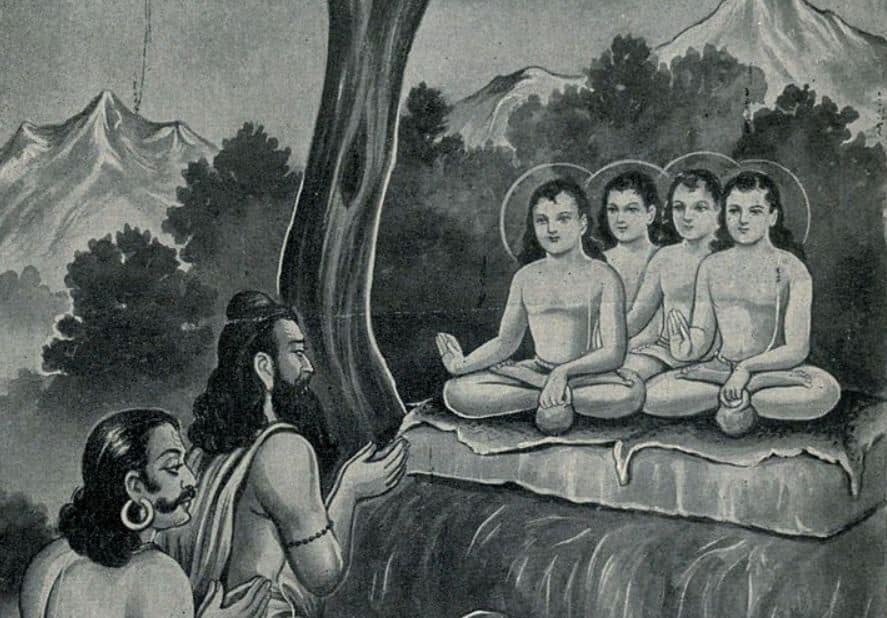
The Bhagavata Purana lists the Kumaras among the twelve mahajanas (great devotees or bhaktas) who, although being eternally liberated souls from birth, still became attracted to the devotional service of Vishnu from their already enlightened state. They play a significant role in a number of Hindu spiritual traditions, especially those associated with the worship of Vishnu and his avatar Krishna, and sometimes even in traditions related to Shiva.
Sanakadika Rishis – This divine group is known by various names: “Kumaras” (the boys/male children/young boys), “Chatursana” or “Chatuh Sana” (the four with names starting with Sana), and “Sanakadika Rishis” (Sanaka and others). Individual names usually include Sanaka (ancient), Sanatana (eternal), Sanandana (ever-joyful) and Sanatkumara (ever-young). Sometimes, Sanatana is replaced by Sanatsujata. A fifth Kumara named Ribhu is sometimes added. Sometimes, the Kumaras are enumerated as six with Sana and Ribhu or Sanatsujata added.
Though in the Mahabharata, a total of seven sons are mentioned, namely: 1) Aniruddha, 2) Sana, 3) Sanatsujata, 4) Sanaka, 5) Sanandana, 6) Sanatkumara, and 7) Sanatana – and further mentions that, “Knowledge comes to these seven rishis, of itself (without being dependent on study or exertion).” These seven are wedded to the religion of Nivritti (inward contemplation).
Sanatkumara
Sanatkumara in Sanskrit means “eternal youth”. He is the author of the Sanatkumara Samhita, part of the Shiva Purana, consisting of 59 chapters. It is also included in the Pañcaratra, Vaishnavite devotional texts. He taught Bhishma the mental and spiritual sciences.
The Chandogya Upanishad, Chapter seven, details Sanatkumara’s teachings on Bhuma-Vidya to the celestial sage Narada. He is also referenced throughout the Mahabharata as a revered sage and spiritual authority in matters pertaining to Yoga.
He is linked to the Tirtha of Kanakhala near Gangadwara or Haridwar, where through extensive tapas, he attained great ascetic powers.
Origin
The Sanakadika Rishis are the eldest mind-born sons of the creator-god Brahma. When Brahma set out to create the universe, he first created beings from different parts of his body. The Kumaras were the first, created from his mind, appearing as infants. Although instructed by Brahma to engage in creation, they refused, choosing lives of celibacy and spiritual devotion.
The Bhagavata Purana explains that Brahma’s wrath at their refusal manifested into Shiva. In another version, Vishnu rewards Brahma’s tapas by manifesting as the four child-sages. Some texts like the Devi Bhagavata Purana and Bhavishya Purana suggest the Sanakadika Rishis appeared before the current age’s Brahma.
They learned the Vedas at the age of four or five. Blessed with the wisdom of jnanis, yogis, and Siddhas, they chose to remain as eternal children. They practiced sannyasa and brahmacharya, wandering naked across realms teaching wisdom. In many traditions, they are celebrated as enlightened Siddhars as well.
They reside in Janaloka or Janarloka (world of intellectuals) or in Vaikuntha, Vishnu’s supreme abode, continuously reciting the mantra Hari Sharanam and living on divine praise alone.
According to Narada, their disciple mentioned in the Padma Purana, though they appear as children, the Sanakadika Rishis are the ancient ancestors of the universe.
Discourses
Their dialogues feature prominently in the Mahabharata and the Bhagavata Purana. In the Shanti Parva, they deliver a discourse to the demon king Vritra and the sage Shukra, glorifying Vishnu as the cosmic absolute.
They divide living beings into six categories by combinations of the three gunas: sattva, rajas, and tamas. The teachings of the Sanakadika Rishis present a spiritual journey from darkness to purity, culminating in moksha through yoga, devotion, and good deeds.
They also visit King Prithu, extolling devotion to Vishnu as the supreme path to self-realization and freedom from worldly desires.
In the Naradiya Purana, each Kumara imparts knowledge to Narada, who later passed it to Vyasa, ensuring the preservation of the Puranas.
Visit to Vaikuntha
During their travels, the Sanakadika Rishis visited Vaikuntha. Upon reaching the seventh gate, they were stopped and mocked by Jaya and Vijaya, the gatekeepers (Dvarapalas) of Vishnu, who mistook them for naked children. Offended, the Kumaras cursed the gatekeepers to be born three times in the material world as enemies of Vishnu.
Vishnu then appeared, calmed the sages, and accepted Jaya and Vijaya as his eternal devotees. As a result of the curse, the gatekeepers were reborn as Hiranyakashipu and Hiranyaksha in Satya Yuga, Ravana and Kumbhakarna in Treta Yuga, and finally Shishupala and Dantavakra in Dvapara Yuga, with each incarnation ultimately defeated by a form of Vishnu.
Conclusion
The Sanakadika Rishis are iconic figures of spiritual renunciation and enlightenment who bridge paths of knowledge (jnana), devotion (bhakti), and meditation (yoga). As eternally youthful sages born of Brahma’s mind, their roles in Hindu cosmology, philosophy, and mythology underscore their eternal relevance and revered status in India’s sacred tradition.