
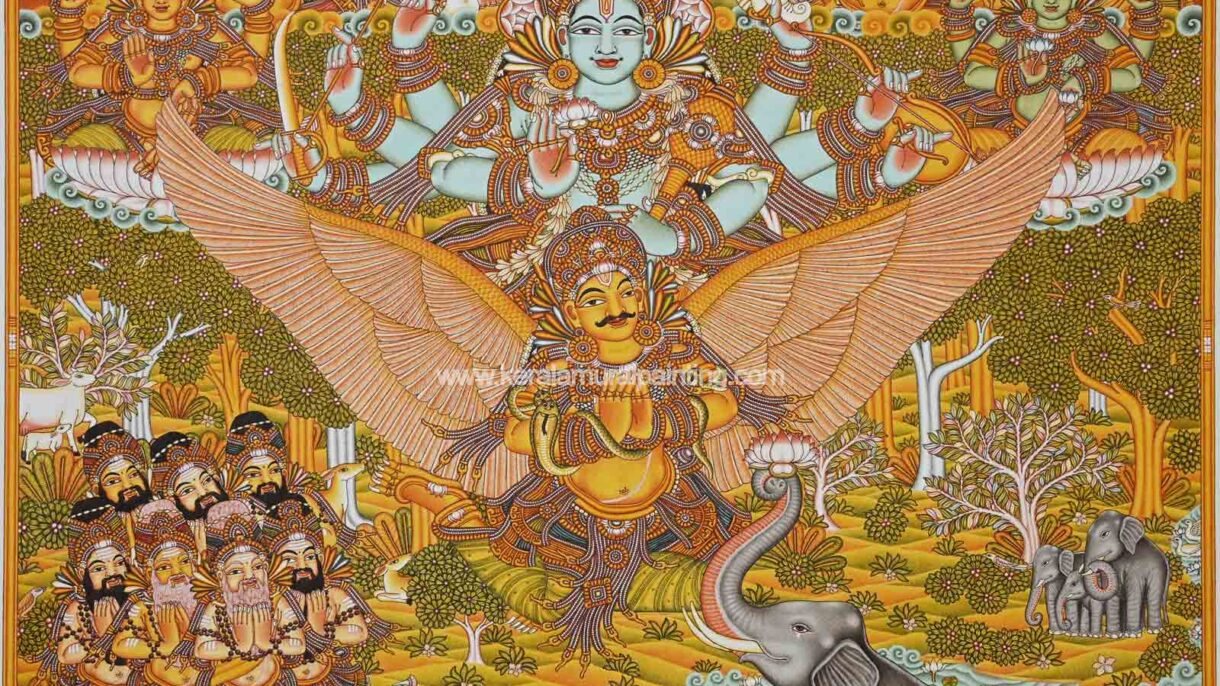
Gajendra Moksham is one of the most powerful and beloved themes in Kerala mural painting. The story brings together devotion, surrender, divine grace, and liberation, making it a particularly meaningful subject for traditional Indian art.
In this Kerala mural painting by Vishnu Vikraman, the timeless story of Gajendra Moksham is presented through the distinctive visual language of Kerala mural art, bringing together vibrant colours, expressive figures, intricate details, and spiritual symbolism.
The Story of Gajendra Moksham
The story of Gajendra Moksham comes from the Bhagavata Purana. Gajendra, the king of elephants, was enjoying a day near a lake when a crocodile seized his leg. Despite his immense physical strength, Gajendra was unable to free himself from the crocodile’s grip.
After struggling for a long time, Gajendra finally understood that his own strength was not enough. In complete surrender, he called upon Lord Vishnu for protection.
Hearing the sincere prayer of his devotee, Lord Vishnu came to Gajendra’s rescue. Riding upon Garuda, his divine vehicle, Vishnu arrived and freed Gajendra from his suffering.
The story ultimately represents the power of sincere devotion and surrender to the divine.
Gajendra Moksham in Kerala Mural Tradition
Gajendra Moksham has a particularly important place in Kerala’s mural heritage. The best-known historic representation is found at Krishnapuram Palace near Kayamkulam in Alappuzha district. Kerala Tourism identifies this approximately 49-square-metre mural as the largest mural panel discovered in Kerala. It portrays Gajendra paying homage to Lord Vishnu, surrounded by divine beings and sages.
The Beauty of the Painting
The Gajendra Moksham theme gives an artist an opportunity to express both movement and emotion.The powerful elephant, the threatening crocodile, the arrival of Garuda, and the majestic presence of Lord Vishnu create a dramatic composition. At the same time, the painting carries an atmosphere of devotion and divine compassion.
Traditional Kerala mural paintings are particularly recognized for their strong outlines, expressive faces, ornamental details, and carefully controlled colour palettes. Traditional mural practice is associated with natural pigments and the Pancha Varna approach, with colours including red, yellow, green, white, and black.
Symbolism of Gajendra Moksham
Beyond the beauty of the image, the story carries a profound symbolic meaning.Gajendra can represent the individual soul caught in the struggles and attachments of worldly life. The crocodile represents the forces that hold us back, while Gajendra’s prayer represents the moment of complete surrender.
Lord Vishnu represents divine protection and grace.
Thus, Gajendra Moksham is not merely a story about an elephant being rescued. It is a spiritual reminder that true devotion transcends physical strength and that surrender can lead to liberation.
Gajendra’s Lotus and the Power of Devotion
One of the most meaningful elements traditionally associated with the story is the lotus offered by Gajendra to Lord Vishnu.The lotus has a deep symbolic presence in Indian art and spirituality. It rises from water while remaining above it, making it a powerful representation of purity, spiritual awakening, and devotion.In the story, Gajendra’s offering is an expression of faith at the moment when he is most vulnerable. His strength has failed, but his devotion remains.
Vishnu and Garuda
The arrival of Lord Vishnu on Garuda adds a powerful sense of movement to the composition.Garuda, Vishnu’s celestial vehicle, is often portrayed with expansive wings and dynamic energy. His presence contrasts beautifully with Vishnu’s divine composure.This combination allows the artist to express two emotions simultaneously: urgency in the rescue and serenity in divine protection.
It is one of the reasons Gajendra Moksham remains such a compelling subject for mural artists.
Gajendra Moksham
The Gajendra Moksham Kerala mural painting celebrates this ancient story through the traditional aesthetics of Kerala mural art.The artwork can be appreciated not only as a depiction of a mythological episode but also as an expression of devotion, craftsmanship, and Kerala’s rich artistic heritage.Every detail—from the expressions of the figures to the ornaments, colours, gestures, and composition—contributes to the storytelling.For an admirer of Indian traditional art, a Gajendra Moksham painting offers something more than visual appeal. It carries a story that has remained meaningful for generations.
A Timeless Message
Perhaps the greatest strength of Gajendra Moksham is that its message remains relevant even today.Life can place us in situations where our own strength and abilities are not enough. The story of Gajendra reminds us of the importance of faith, humility, surrender, and hope.That timeless message is what makes Gajendra Moksham such a powerful subject in Kerala mural painting.
Bringing Tradition Into Contemporary Spaces
A Kerala mural depicting Gajendra Moksham can become a striking focal point in a home, office, meditation space, hotel, or cultural interior.Its combination of mythology, vibrant colours, expressive characters, and traditional craftsmanship allows it to connect beautifully with both classical and contemporary surroundings.More importantly, displaying such an artwork allows a piece of Kerala’s artistic heritage to become part of everyday life.
Conclusion
Gajendra Moksham is a story of devotion, surrender, divine grace, and liberation. Through the Kerala mural tradition, this powerful story becomes a visual experience filled with colour, emotion, symbolism, and craftsmanship.The Gajendra Moksham mural by Vishnu Vikraman continues this tradition by bringing an ancient spiritual story into a contemporary artistic context.It is more than a painting of Lord Vishnu and Gajendra. It is a reminder that when faith is sincere and the heart surrenders completely, hope can emerge even in the most difficult moment.
Gajendra Moksham — a timeless story, preserved through the colours and spirit of Kerala mural art.