
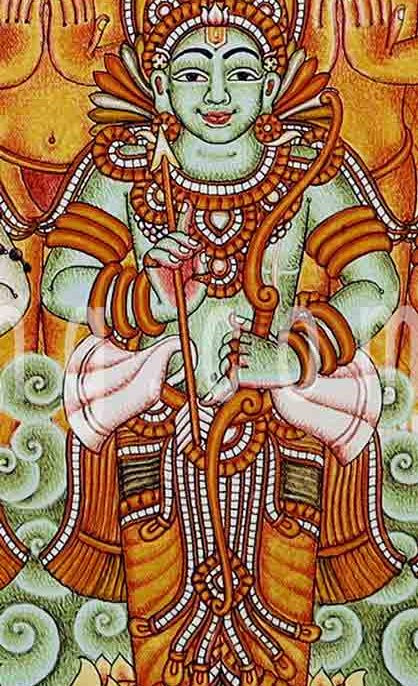
The Rama avatar of Lord Vishnu is one of the most revered incarnations in Hinduism. As the seventh avatar of Vishnu, Lord Rama’s life story exemplifies the eternal battle between good and evil, and the victory of dharma (righteousness) over adharma (unrighteousness). His tale is immortalized in the ancient Indian epic, the Ramayana, written by the sage Valmiki.
Birth and Royal Origins
Born in the sacred city of Ayodhya, Lord Rama was the eldest son of King Dasharatha and Queen Kausalya. His birth was the result of a divine boon granted to Dasharatha by the gods, for the purpose of restoring balance on Earth. Even as a young prince, Rama was admired for his calmness, moral strength, humility, and adherence to truth.
He married Sita, the princess of Mithila, in a swayamvara after stringing Lord Shiva’s mighty bow—an act that proved his divine strength and destiny.
Exile and Life in the Forest
Just as he was to be crowned king, palace politics turned his life around. Due to a promise made by King Dasharatha to his stepmother Kaikeyi, Rama was exiled to the forest for 14 years. Without hesitation, Rama accepted the exile, upholding truth and duty above personal desire. His wife Sita and loyal brother Lakshmana chose to accompany him, showcasing deep familial love and loyalty.
The forest years were not easy. The trio encountered demons, sages, and wild terrains. Rama upheld justice wherever he went, protecting sages and restoring balance in the regions they passed.
The Abduction of Sita and War Against Ravana
The most significant challenge came when the demon king Ravana of Lanka abducted Sita. This act was not just personal—it represented the cosmic clash between good and evil. Rama’s grief was profound, but he remained focused and determined to rescue her.
With the help of Hanuman, Sugriva, Jambavan, and a mighty army of vanaras (monkey warriors) and bears, Rama marched to Lanka. In the climactic battle, Rama defeated Ravana with divine strength, strategic brilliance, and unwavering virtue. This victory not only reunited him with Sita but also restored dharma to the world.
The Return to Ayodhya and Reign as an Ideal King
After completing his exile, Rama returned to Ayodhya, where he was welcomed with celebration and joy. His return is commemorated as Diwali, the Festival of Lights. Rama’s reign, known as Rama Rajya, is considered the golden era of righteousness, justice, and peace. It stands as a model of ideal governance and leadership, where the king ruled with fairness and compassion.
The Symbolism and Teachings of Rama Avatar
The Rama avatar is more than just a heroic tale—it’s a moral compass. Every aspect of his life is filled with spiritual symbolism:
Rama symbolizes dharma, righteousness, and ideal manhood.
Sita represents purity, devotion, and patience.
Lakshmana embodies loyalty and brotherhood.
Hanuman is the perfect devotee, known for courage, humility, and selfless service.
Ravana, though a scholar and king, shows how unchecked ego and desire lead to ruin.
The Ramayana teaches us to uphold our duties even in adversity, to stay devoted to truth, and to lead with compassion and strength. It continues to inspire generations across India and the world, being translated into many languages and performed in dramas and dances.
Cultural and Spiritual Impact
The story of the Rama avatar is not just scripture—it is living tradition. Festivals like Rama Navami (his birth) and Diwali celebrate key moments from his life. Temples dedicated to Lord Rama can be found throughout India and beyond, where his virtues are chanted, sung, and remembered.
Artists, poets, philosophers, and saints like Tulsidas (author of Ramcharitmanas) have added new layers of meaning to Rama’s life over centuries, making it one of the most deeply ingrained spiritual and cultural foundations of Indian civilization.
Conclusion: Rama Avatar – A Divine Blueprint for Life
The Rama avatar represents the ideal human being—a devoted son, a loving husband, a protective brother, a wise ruler, and a fearless warrior. His life teaches us that true greatness lies in selflessness, integrity, and unwavering faith. In every stage of his journey, Rama reminds humanity of the importance of standing for what is right, no matter how difficult the path.