
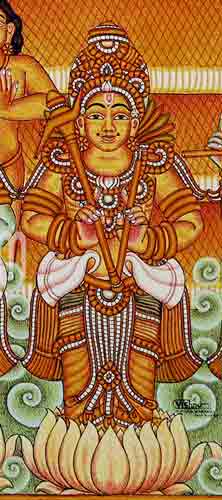
Lord Vishnu incarnated as Parashurama avatar, known as “Rama with an axe,” to restore cosmic balance and righteousness during a turbulent period marked by the oppression of people by corrupt and arrogant Kshatriya rulers. This sixth avatar of Vishnu is unique as he combines both the spiritual wisdom of a Brahmin and the fierce warrior spirit of a Kshatriya, embodying divine justice and retribution.
The Legend and Mission of Parashurama Avatar
Born to sage Jamadagni and his wife Renuka, Parashurama was destined for a divine purpose. His birth came at a time when Kshatriya kings, entrusted with protecting dharma (righteousness), had instead begun abusing their power, tyrannizing the common people and disrespecting the Brahmins. The tipping point in this epic saga was when King Kartavirya Arjuna, a powerful Kshatriya, forcefully seized Jamadagni’s magical cow Kamadhenu, which provided endless resources. Enraged by this sacrilege, Parashurama killed the king but soon faced an even greater tragedy when the king’s son killed his father in revenge.
Overcome with grief and anger, Parashurama resolved to rid the earth of the corrupt Kshatriyas once and for all. He vowed to eliminate them twenty-one times, mirroring the twenty-one times his mother had pounded her chest in sorrow. True to his vow, Parashurama embarked on a fierce campaign, traveling the lands and vanquishing the oppressive Kshatriya rulers across the earth through a series of twenty-one battles. After fulfilling this vow, he performed the Ashvamedha sacrifice and gifted the conquered lands to Brahmins, restoring their rightful social and spiritual authority
Symbolism and Significance of the Parashurama Avatar
Parashurama’s axe (Parashu) is a powerful symbol of righteous anger and divine retribution. It represents the ability to strike down evil and ignorance when all peaceful efforts fail. Unlike other Vishnu avatars who often symbolize protection through compassion or divine play, Parashurama embodies the fierce and unyielding side of divine justice.
This avatar emphasizes that power and authority must never be abused and must be balanced by virtue and responsibility. Parashurama’s destruction of the corrupt Kshatriyas serves as a cosmic correction to restore dharma and ensure that those entrusted with power act righteously.
More than just a warrior, Parashurama is also revered as a sage and teacher. He is credited with mentoring important figures in Hindu epics, such as Bhishma, Drona, and Karna in the Mahabharata, imparting not only martial skills but spiritual wisdom. Moreover, he is considered immortal (Chiranjivi), destined to live through ages and serve as the military teacher for Vishnu’s final avatar, Kalki, who will appear at the end of Kali Yuga to restore righteousness once again
Parashurama’s Role in Hindu Cosmology and Cultural Legacy
In Hindu cosmology, Parashurama’s avatar underscores the cyclical nature of time and cosmic balance. Whenever dharma is endangered by tyranny and injustice, divine intervention is necessary to re-establish order. Parashurama’s stern but just action reinforces the principle that evil cannot be tolerated indefinitely and must be rooted out decisively.
Regional traditions also link Parashurama with specific geographical legends. For instance, the coastal region between Karnataka and Maharashtra, known as Parashuramkshetra, is believed to have been reclaimed from the sea by Parashurama’s divine power. Some accounts state that he still lives in meditation at the Mahendragiri Mountain in Odisha, awaiting the time to train Kalki
Conclusion: Parashurama Avatar as a Symbol of Justice and Balance
The Parashurama avatar represents the relentless pursuit of justice, the righteous use of power, and the restoration of cosmic order in Hindu mythology. Through his incredible feats and unwavering commitment, Parashurama teaches enduring lessons on the balance of power, the responsibility of rulers, and the sanctity of dharma. He remains a figure of awe and reverence—a warrior sage who stands as a guardian against tyranny and protector of the oppressed.