
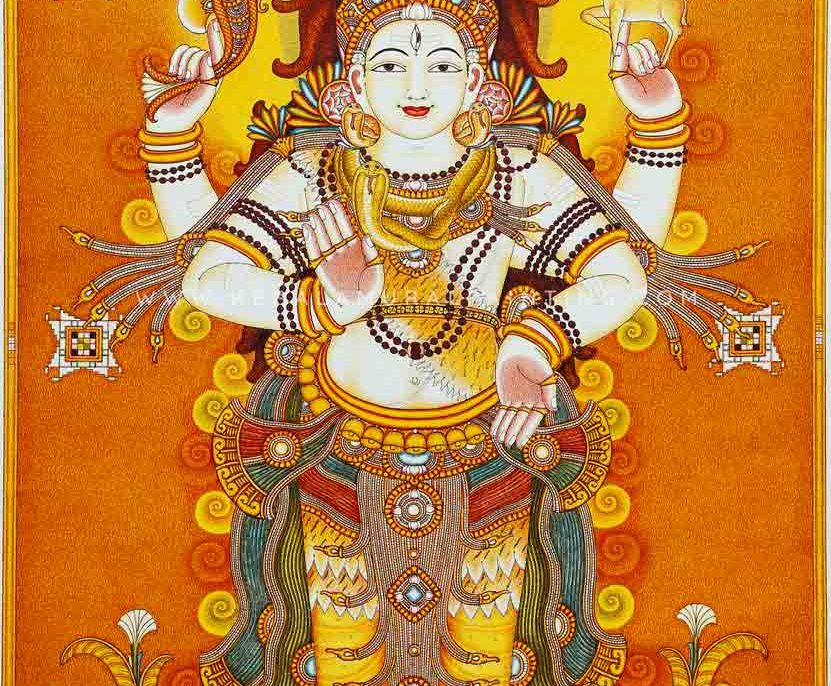
Key Attributes and Symbols:
1. Appearance:
- Third Eye: Symbolizes his ability to see beyond the ordinary and destroy evil.
Crescent Moon: Represents the cycle of time. - Ashes: Signify his mastery over physical and material existence.
- Trident (Trishula): Represents his power over creation, preservation, and destruction.
- Serpent: Worn around his neck, symbolizing power over deadly forces.
Every stroke of this shiva mural painting was guided by reverence and deep study of ancient symbolism.
2.Symbols:
- Linga: A symbol of Shiva used for worship in temples, representing his formless nature.
- Nandi: His bull, symbolizing strength and righteousness, and serves as his mount.
3.Family:
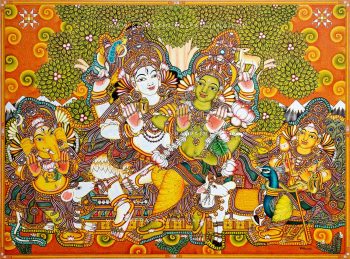
- Parvati: His consort, also known as Shakti or Durga.
- Ganesha: His son, the remover of obstacles.
- Kartikeya (Skanda): Another son, the god of war.
The depiction of Shiva along with Parvati in shiva parvati mural painting themes often enhances the balance of divine masculine and feminine energy. It’s a popular composition, especially in kerala mural painting shiva parvati artworks.
4.Nataraja:
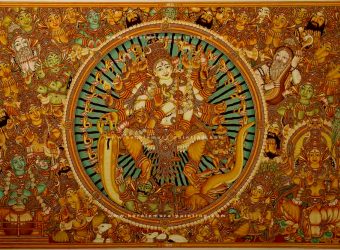 One of the most famous depictions of Shiva is as Nataraja, the Lord of the Dance. In this form, Shiva performs the cosmic dance of creation, preservation, and destruction. Such poses are beautifully captured in easy shiva mural painting styles and also in traditional shiva mural painting formats.
Key Legends and Stories:
- Destruction of Kama: In one legend, Shiva burns Kama, the god of love, to ashes with his third eye when Kama attempts to disrupt his meditation.
- Ganga’s Descent: Shiva catches the descending Ganga river in his matted hair to prevent her from flooding the earth.
- Samudra Manthan: During the churning of the ocean, Shiva drinks the poison (Halahala) that emerges to save the universe, which turns his throat blue, earning him the name Neelkanth.
There are many mythological stories surrounding Shiva, detailing his various exploits, battles, and interactions with other gods, demons, and sages. These stories are found in ancient Hindu texts such as the Puranas and the Mahabharata, and they often serve as inspiration for mural painting shiva parvathi depictions.
Worship and Festivals:
- Maha Shivaratri: The great night of Shiva, celebrated with fasting, night-long vigils, and offerings to Shiva.
- Shravan Month: Especially sacred for Shiva worship, involving fasting and special prayers on Mondays.
Philosophical Significance:
Shiva represents the essential paradox of destruction and regeneration, the cyclical nature of existence. He embodies both the ascetic and householder, symbolizing the balance of life’s dualities. This concept is deeply rooted in kerala mural painting shiva themes that aim to capture both the meditative stillness and cosmic dynamism.
Temples and Pilgrimage Sites:
- Kedarnath: One of the twelve Jyotirlingas and a significant pilgrimage site in the Himalayas.
- Kashi Vishwanath: Another Jyotirlinga located in Varanasi, one of Hinduism’s holiest cities.
- Amarnath Cave: Famous for its natural ice Shiva Lingam.
Lord Shiva’s worship transcends geographical and cultural boundaries, reflecting his multifaceted nature and the profound spiritual and philosophical concepts he embodies. Overall, Shiva mural painting art forms celebrate this divine symbolism, capturing it in visual language that connects the earthly with the eternal.