
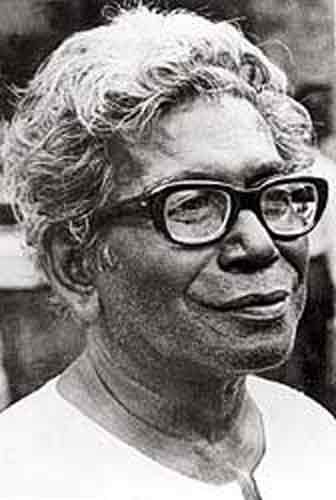
Ramkinkar Baij: Pioneer of Modern Indian Sculpture and Abstract Art
Ramkinkar Baij was the earliest Indian artist to experiment with abstract sculptural forms. His oil on canvas paintings have a singular experimenting quality, going beyond their time, unregimented by dogmas and with only one commitment – to be unstintingly creative.
Born in Bankura in West Bengal in 1910, Ramkinkar Baij studied at the Kala Bhavan, Vishwa Bharati University, Santiniketan in 1925. Trained by two European sculptors — one of whom was a disciple of Bourdelle — who were visiting Santiniketan on an invitation by Tagore, his style remained uniquely his own. Groomed by his mentors, Nandalal Bose and Tagore, the clay modeler turned artist began shaping modern Indian art. Working at a time when traditional art was transitioning to modernism, Ramkinkar Baij’s work became a pivotal contribution to Indian art history. Nature and his own folk background deeply influenced the formation of his distinctive style. Later, he went on to head the Department of Sculpture at Kala Bhavan.
Ramkinkar Baij believed that momentum is what creates tension in a work of art. His creations are characterized by tremendous energy — joyous, vital, and constantly reaching toward light. His art is earthy and dynamic, often revealing a surging sense of movement or growth. His path-breaking work in sculpture has been widely acknowledged and respected — first in Santiniketan, then across India, and eventually on the international stage. His sand and pebble sculptures, in particular, are noted for a lyrical, metrical sensuality and an extraordinary oneness with nature. Indian sculpture, previously confined to academic naturalism, was revolutionized by the vision of Ramkinkar Baij.
If you’re inspired by the richness of Indian art traditions — from Ramkinkar Baij’s modernist sculptures to the intricate beauty of Kerala mural painting — and would like to commission a custom mural, get in touch with us here.